



TL;DR
- Ranking is not the same as being the website Google “picks.”
- Google matches the best result to a specific search, at a specific moment.
- A page can be crawled but never indexed.
- A page can be indexed but barely rank.
- A page can rank #1 for one query and nowhere for another.
- Relevance comes first, quality comes next, experience breaks ties.
- More keywords, more words, and more content don’t guarantee a higher spot.
Search Engines Don’t Rank “Websites.” They Rank Answers.
A common misunderstanding: Google doesn’t sit down and decide which website deserves to rank first. It decides which result is the best match for one specific search, at one specific moment, based on relevance, quality, usefulness, context, and dozens of other signals.
Crawling and indexing are prerequisites for ranking, not the same thing as ranking. A simple way to picture it:
Discovery → Crawling → Rendering/Understanding → Indexing → Retrieval → Ranking → SERP presentation
That order matters, because it explains three things beginners usually get wrong:
- A page can be crawled but not indexed.
- A page can be indexed but barely rank for anything.
- A page can rank highly for one query and be invisible for a closely related one.
Each stage filters pages further. Getting through one stage says nothing about the next, and understanding this flow is the real starting point if you want to get ranked on Google for the searches that matter to your business.
1. Search Engines First Try to Understand What You Actually Mean
Before Google ranks anything, it tries to decipher intent. Its systems interpret spelling, synonyms, language, and local context instead of just matching exact words, and Google notes this synonym and language-understanding system improves results across a large share of searches. (Google)
In practice, this means a useful page doesn’t need to repeat your target phrase word-for-word a dozen times. Google can connect related concepts and phrasing to the same underlying intent.
2. Relevance: Does the Page Actually Answer the Search?
This is arguably the strongest ranking factor. Before anything else, Google needs confidence that a page satisfies the intent behind a query, not just that it contains the keyword somewhere on the page.
Compare two pages about “how to improve your website SEO“: one stuffed with the phrase repeatedly but short on substance, and one that actually walks through the steps, trade-offs, and common mistakes. The second wins, because it resolves the search rather than just mentioning it.
3. Quality: Why Two Relevant Pages Don’t Rank Equally
Once several pages are relevant, Google has to decide which one is more trustworthy and useful, this is where generic competitors stop, and where you can actually pull ahead. Google looks for signals of expertise, authoritativeness, and trustworthiness, including whether other prominent, reputable sites link to or reference the content.
In practice, that means:
- Original information, not recycled summaries
- First-hand experience with the topic
- Expert input or review
- Accurate sourcing and clear authorship
- Real topical depth, not a surface-level overview
- External references that back up claims
4. Backlinks Still Matter, Just Not However You Think
Google confirms link analysis, including PageRank, remains part of its core ranking systems.
But “more links equals higher rankings” is an oversimplification. One relevant, editorial link from a recognized industry publication can carry far more weight than dozens of unrelated, low-quality links.
Backlinks are one of the clearest outside signals feeding into Google organic ranking, treat them as external evidence that credible parts of the web recognize your page, not as a number to inflate.
5. Google Evaluates Passages, Not Just Whole Pages
Google’s ranking systems include a passage-ranking system, which identifies individual sections of a page that are especially relevant to a search, even if the rest of the page covers something broader.
This is why structure matters: clear H2s and H3s, question-based headings, direct answers near the top of a section, focused paragraphs instead of sprawling ones, and a logical, scannable flow. Not because headings “magically” boost rankings, but because organized content is easier for both people and systems to understand and extract.
6. Freshness Matters Only When the Query Needs It
Google prefers fresher content specifically when freshness is relevant to the search, through what it describes as “query deserves freshness” systems.
A search about a recent product launch benefits from recency. A search for “how photosynthesis works” doesn’t need a 2026 update to stay accurate.
7. Page Experience Helps, But It Can’t Rescue Bad Content
Competitor articles often treat page speed as equally decisive as content. Google’s own documentation is more nuanced: Core Web Vitals are used by ranking systems, but excellent page-experience scores don’t guarantee top rankings, and genuinely relevant content can still outrank a faster page.
Priority order: relevance first, quality next, experience becomes a bigger tiebreaker once several pages are otherwise strong candidates. That covers Core Web Vitals (LCP, INP, CLS), mobile usability, intrusive pop-ups, and general accessibility.
What Does NOT Automatically Get You Ranked on Google
If you’re trying to improve your website ranking on Google, it helps to rule out what doesn’t move the needle first:
- More keywords. Repeating a phrase doesn’t make a page more relevant; it can make it worse.
- Longer articles. 3,000 words isn’t automatically better than 1,200 genuinely useful ones.
- Perfect Core Web Vitals. Good scores don’t guarantee rankings on their own.
- Running Google Ads. Paying for ads never improves organic rankings; Google keeps ads and organic ranking fully separate.
- Publishing more content. A hundred weak articles rarely outperforms twenty genuinely useful ones.
- Schema markup alone. Structured data helps systems understand content and can unlock certain search features, but it isn’t a shortcut to the top spot.
- Exact-match keywords everywhere. Modern systems understand related concepts and synonyms, so forced repetition adds little.
Real Example: How SEO Increased StarlineSalt’s Organic Traffic
We worked on our client’s website, StarlineSalt, following the fundamentals covered above: clear intent-matching content, solid structure, and accurate information.
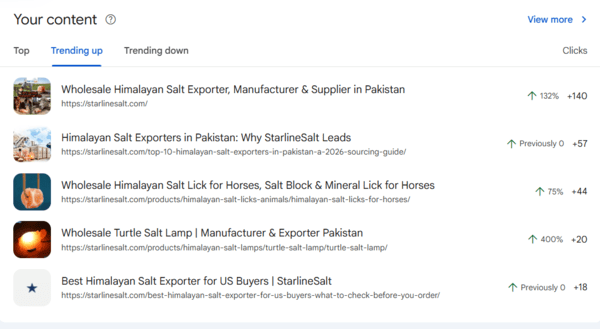
These results highlight how relevant content, proper structure, and consistent SEO efforts can improve organic search visibility.
Frequently Asked Questions
1. What’s the fastest way to get ranked on Google?
There’s no guaranteed “fast” path, but publishing genuinely useful, well-structured content on a technically healthy site gives you the best odds of being crawled, indexed, and considered relevant quickly.
2. How do I get your website on Google first page?
Focus on matching real search intent, demonstrating expertise and trustworthiness, earning relevant backlinks, and maintaining solid page experience. No single tactic does this alone.
3. Why is my page indexed but not ranking for my target keyword?
Indexing only means Google has stored the page. Ranking depends on relevance and quality compared to every other page competing for that same query.
4. What does it actually take to improve your website SEO?
Not usually a full rewrite. It often means tightening structure, strengthening intent-match, and improving authority signals on what you already have.
5. How much do backlinks affect organic search ranking?
They’re still meaningful, but one relevant link from a reputable site outweighs many low-quality ones. Quality and relevance matter more than raw link count.


